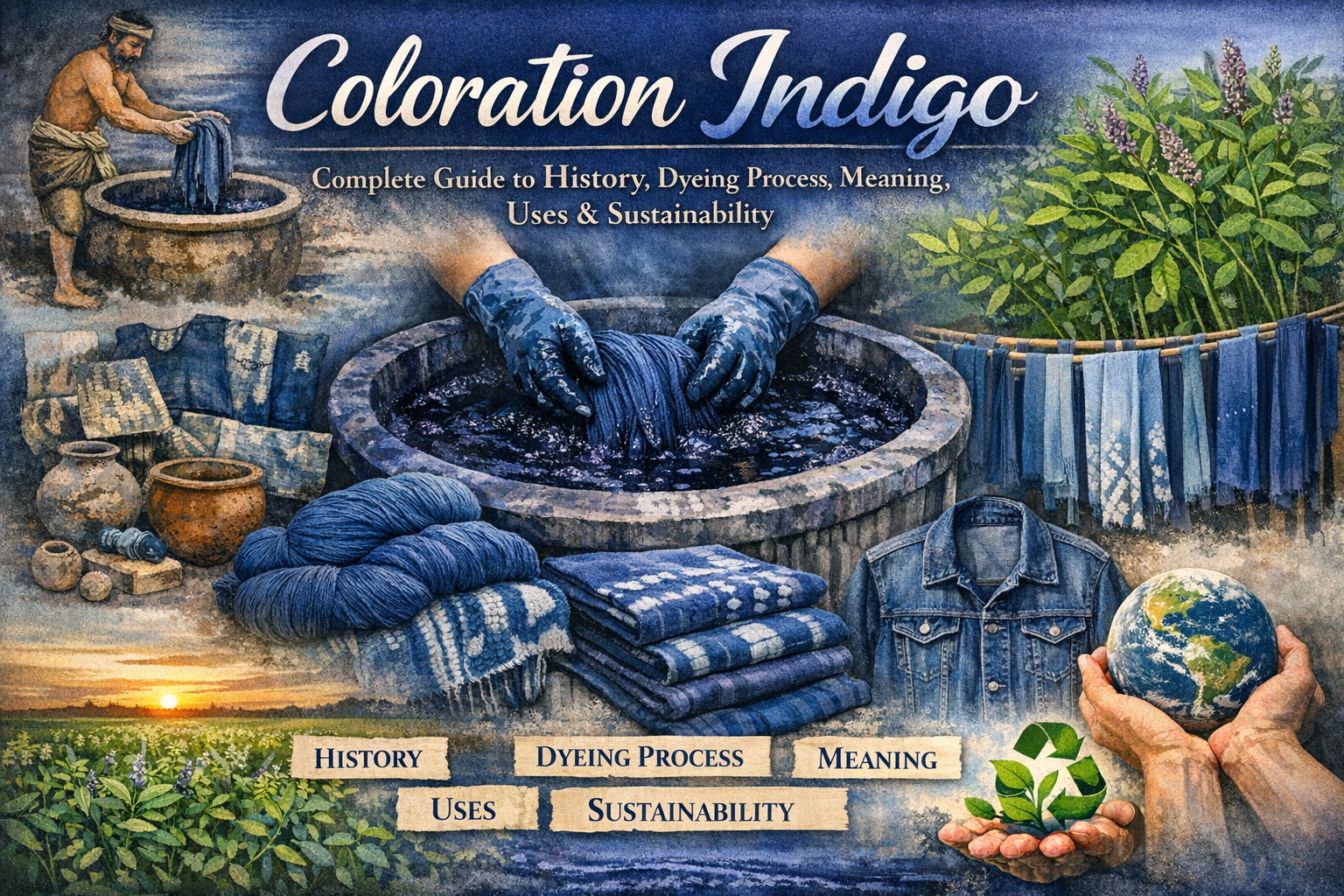
Introduction to Coloration Indigo
Coloration indigo refers to the profound deep blue hue produced by indigo dye — one of the most historically significant and culturally rich colorants in human history. Unlike ordinary blue dyes, indigo has been revered across civilizations for thousands of years, influencing fashion, art, trade, and even social symbolism. It remains embedded in global culture today, from artisan textiles to modern denim.
In this comprehensive guide, we explore indigo’s journey from ancient botanical origins to its role in modern industry, its environmental implications, and why this mythical blue continues to captivate designers, scientists, and cultures worldwide.
What Does Coloration Indigo Mean?
At its essence, coloration indigo is the distinctive deep blue tone derived from the indigo dye. Traditionally extracted from plants like Indigofera tinctoria and other species, indigo produces a unique blue that sits between blue and violet on the color spectrum.
The term “indigo” itself comes from the Latin indicum, meaning “Indian,” since the dye was originally imported into Europe from the Indian subcontinent — the earliest major source of high-quality indigo dye.
Why Indigo Is Considered a Timeless Color
Indigo is more than just a color — it’s a cultural phenomenon. Its deep, rich tone evokes strength, calmness, and depth, making it valuable in everything from fashion and textiles to spiritual symbolism. Because indigo dye does not penetrate fibers fully but instead clings to the surface, garments like denim gain a lived-in look over time, increasing their aesthetic and emotional value.
Indigo’s enduring popularity stems from this blend of visual appeal, historical legacy, and symbolic meaning, making it far more than a dye — it’s a story woven into fabric.
The Origin and History of Indigo Coloration
Early Use of Indigo in Ancient Civilizations
Indigo is one of the world’s oldest known dyes, with direct evidence of its use dating back over 6,000 years. Archaeological findings in Huaca Prieta, Peru, reveal indigo-dyed textiles from as early as 4000 BC — predating ancient Egyptian uses by centuries.
The ancient Egyptians, Mesopotamians, and subsequent civilizations all prized indigo for its deep blue hue. It was traded across continents long before synthetic dyes were conceptualized, making it a cornerstone of early global commerce.
Indigo in India, Egypt, China, and Africa
India became the foremost center of indigo cultivation and trade. Species like Indigofera tinctoria were domesticated, cultivated, and exported to civilizations across Asia, Africa, and Europe. Its extraction techniques were highly refined, contributing to India’s dominant position in the early indigo economy.
Indigo dye was also important in West Africa, where master dyers developed elaborate communal dye pits and textiles signifying wealth and social status. Indigenous textile traditions incorporated indigo into ceremonial garments, weaving social identity into color.
Indigo as “Blue Gold” in Global Trade
Because of its rarity, longevity, and unique blue hue, indigo was historically called “blue gold.” In the 19th century alone, regions like Bengal devoted over 7,000 km² to indigo cultivation for international markets — an area larger than the nation of Luxembourg.
During the colonial era, indigo agriculture became tied to exploitative practices. In Bengal, forced indigo cultivation sparked the Indigo Revolt of 1859 — one of the earliest peasant uprisings against colonial oppression. This blend of economics, politics, and culture underscores the deep impact of coloration indigo beyond textiles alone.
Botanical Sources of Natural Indigo
Indigofera and Other Dye-Producing Plants
Natural indigo dye primarily comes from plant species in the Indigofera genus — especially Indigofera tinctoria and Indigofera suffruticosa. There are over 750 species of Indigofera, many of which have historically provided indigo pigment for dyeing.
These plants thrive in tropical climates, with warm temperatures and well-drained soils enabling higher yields of dye precursors. Vegetative growth is essential, as indigo pigment is not in the roots but in the leaves.
Indican and the Formation of Indigo Pigment
Indigo dye doesn’t exist in the plant as pure blue pigment. Instead, it’s stored in leaves as a compound called indican. Upon fermentation and oxidation, indican is chemically transformed into indigotin — the deep blue pigment that gives indigo its signature color.
The production process requires careful timing and skilled handling, since conversion from indican to indigotin relies on microbial activity and controlled oxidation.
How Natural Indigo Dye Is Made (Step-by-Step)
Harvesting and Preparation
Natural indigo dye production begins with harvesting mature leaves. These are soaked and fermented in large vats of water, where enzymes and microbes break down indican. After fermentation, oxidization occurs when the liquid is exposed to air, precipitating the blue pigment.
Oxidation and Color Transformation
Initially, the dye liquor may appear greenish or yellow. Only after aeration does the classic blue deepen as indigotin forms. This oxidation step is crucial — without it, indigo won’t develop its signature color.
Drying and Powdering
Once pigment precipitates, it’s separated, dried, and often compressed into cakes or powder that dyers can use later. In traditional settings, this process results in unique regional variations based on plant species and local techniques.
Synthetic Indigo and Modern Industrial Production
Invention of Synthetic Indigo
The chemistry of indigo changed dramatically in the late 19th century. After Adolf von Baeyer elucidated the chemical structure of indigo in 1883, synthetic production processes were developed that allowed for consistent, scalable dye manufacture.
Synthetic indigo accounted for the majority of indigo produced worldwide by the early 20th century, effectively replacing natural indigo for mass markets due to its lower cost and uniform quality.
Chemical Composition and Industrial Methods
Modern synthetic indigo is typically derived from petrochemical precursors through complex chemical reactions that yield highly pure indigotin. Synthetic production approaches now produce over 70,000 tons of indigo annually, most of which goes into dyeing denim and textiles.
While industrial processes dominate the market, concerns over sustainability and chemical waste have prompted innovation toward eco-friendly synthesis and biological production routes using engineered microbes.
Traditional Indigo Dyeing Techniques Around the World
Vat Dyeing Explained
Indigo dyeing, whether natural or synthetic, typically uses a vat dyeing process. Since indigo is insoluble in water, it must first be reduced into a soluble form called leuco-indigo before fibers can absorb it. After immersion, exposure to oxygen reverses the process, regenerating insoluble indigotin inside the fibers.
Japanese Shibori Indigo Dyeing
Japan’s indigo traditions, such as Shibori, have existed for centuries and are recognized as integral cultural practices. Some artisanal methods — like the 800-year-old sukumo fermentation — are still upheld today despite competition from industrial dyeing.
Shibori involves folding, binding, or compressing fabric before dyeing, creating intricate patterns rooted in deep cultural symbolism and craftsmanship.
Resist and Tie-Dye Techniques in India & Africa
Across India and West Africa, textile artisans developed resist dyeing and tie-dyeing methods using indigo to produce striking geometric designs, ceremonial cloths, and textiles with embedded cultural meanings. These techniques built communities of skilled dyers and often carried symbolic significance tied to identity and status.
Indigo Color Characteristics and Properties
Where Indigo Sits on the Color Spectrum
Indigo occupies a unique position between blue and violet. While not universally agreed upon in scientific circles, many sources place indigo within the 420–450 nm wavelength range on the electromagnetic spectrum.
In the world of pigments, indigo has a deep, velvety depth that cannot be precisely replicated by most synthetic blues.
Durability and Fading Behavior
Unlike dyes that bind deeply into fibers, indigo often resides closer to the surface, contributing to its characteristic fading — especially in denim. This fading isn’t a weakness; it’s a celebrated feature of indigo garments, giving each piece a unique story as it ages.
Indigo in Fashion and Denim
Indigo in Jeans and Denim Fabric
Denim is perhaps the most recognizable modern embodiment of coloration indigo. Today, over one billion pairs of jeans worldwide are dyed with indigo, making it a global staple of casual fashion.
While original denim yarns were dyed by hand, modern textile mills use automated rope and sheet dyeing machines to apply several dips of dye and ensure consistent saturation.
Why Indigo Denim Fades with Wear
The unique position of indigo dye molecules — chiefly on the surface of fibers — allows them to gradually wash and wear away, creating personalized variations in color. This fading process has become a hallmark of quality denim and a point of pride for enthusiasts.
Indigo in Modern Clothing and Accessories
Beyond denim, indigo dye appears in shirts, scarves, bags, and accessories — often used by designers to evoke vintage sophistication or artisanal authenticity. Its adaptability has helped it remain relevant across fashion eras.
Indigo in Art, Design, and Creativity
Indigo isn’t limited to textiles. Artists use indigo pigments in painting, printmaking, ceramics, and mixed media to exploit its deep tonal range. In interior design, indigo evokes tranquility and richness, pairing beautifully with neutral palettes and natural materials.
Graphic designers may use indigo in branding to convey trust, stability, and depth, making it popular in corporate identities and creative projects.
Cultural and Symbolic Meaning of Indigo Coloration
Across cultures, indigo carries layered symbolism:
- Spirituality & Insight: Often linked with intuition and inner wisdom.
- Wealth & Status: In many ancient societies, indigo garments signified prestige and luxury.
- Calmness & Depth: Indigo’s deep tone is associated with reflection and serenity.
These meanings continue to influence fashion, art, and even psychological interpretations of color today.
Indigo in Nature and the Environment
Indigo tones appear in nature — twilight skies, deep ocean waters, some flowers, and bird plumage. These natural references help explain why the color resonates universally: it evokes vastness, depth, and harmony.
Environmental Impact and Sustainability of Indigo Dye
Environmental Issues with Traditional Indigo Dyeing
Both natural and synthetic indigo dyeing have environmental footprints. Traditional dyeing can consume large volumes of water and produce effluent that, if untreated, harms ecosystems. Synthetic indigo production involves harmful chemicals and petrochemical intermediates.
Eco-Friendly and Sustainable Indigo Practices
Sustainable alternatives include organic cultivation, closed-loop dyeing systems that recycle water, biodegradable auxiliaries, and biological synthesis routes using engineered bacteria. Scientists are actively exploring these pathways to reduce dependence on petrochemicals while preserving indigo’s cultural legacy.
Uses of Coloration Indigo Today
Indigo remains widely used in:
- Clothing & Textile Manufacture
- Traditional Handicrafts & Artisan Textiles
- Home Furnishing & Décor
- Art & Illustration
- Graphic Design & Branding
Its versatility ensures it remains relevant across domains.
Natural Indigo vs Synthetic Indigo: Key Differences
| Feature | Natural Indigo | Synthetic Indigo |
| Source | Plant-based | Chemical synthesis |
| Cost | Higher | Lower |
| Color Variation | Unique, subtle | Uniform, consistent |
| Environmental Impact | More eco-friendly if organic | Varies depending on process |
| Cultural Value | High | Moderate |
Natural indigo is cherished for depth and variation, while synthetic indigo enables scalable industrial use.
Frequently Asked Questions About Coloration Indigo
What Is Coloration Indigo?
It’s the deep blue color produced by indigo dye, sourced naturally or synthetically.
Is Indigo a Natural or Synthetic Color?
Both — historically natural, but mostly synthetic in modern textile production.
Why Is Indigo Used in Denim?
Its unique fade characteristics and visual appeal make it ideal for denim fashion.
Does Indigo Dye Fade?
Yes — slow surface wear contributes to the personalized look of indigo garments.
Is Indigo Dye Eco-Friendly?
Natural processes can be sustainable, but synthetic production has environmental concerns, prompting eco-innovations.
Why Coloration Indigo Still Matters in the Modern World
Indigo continues to shape fashion, art, and cultural expression centuries after its first use. From blue gold in ancient trade to timeless denim in modern closets, its story bridges past and present, blending aesthetics, science, and heritage.
Future of Indigo Coloration
The future of indigo lies in sustainable innovation, where chemistry, biotechnology, and tradition merge. Emerging green synthesis methods and stronger environmental standards promise to keep indigo relevant while minimizing ecological impact.
Whether through artisanal hand-dyeing or high-tech production, coloration indigo continues its journey — deep, rich, and impactful.
Conclusion
Coloration indigo is more than a color — it’s a legacy. From ancient civilizations to modern fashion runways, from traditional vats to scientific laboratories, indigo dye captures imagination and meaning unlike almost any other pigment.
Understanding its history, science, cultural significance, and environmental context allows us to appreciate not only its visual beauty but its enduring human value.