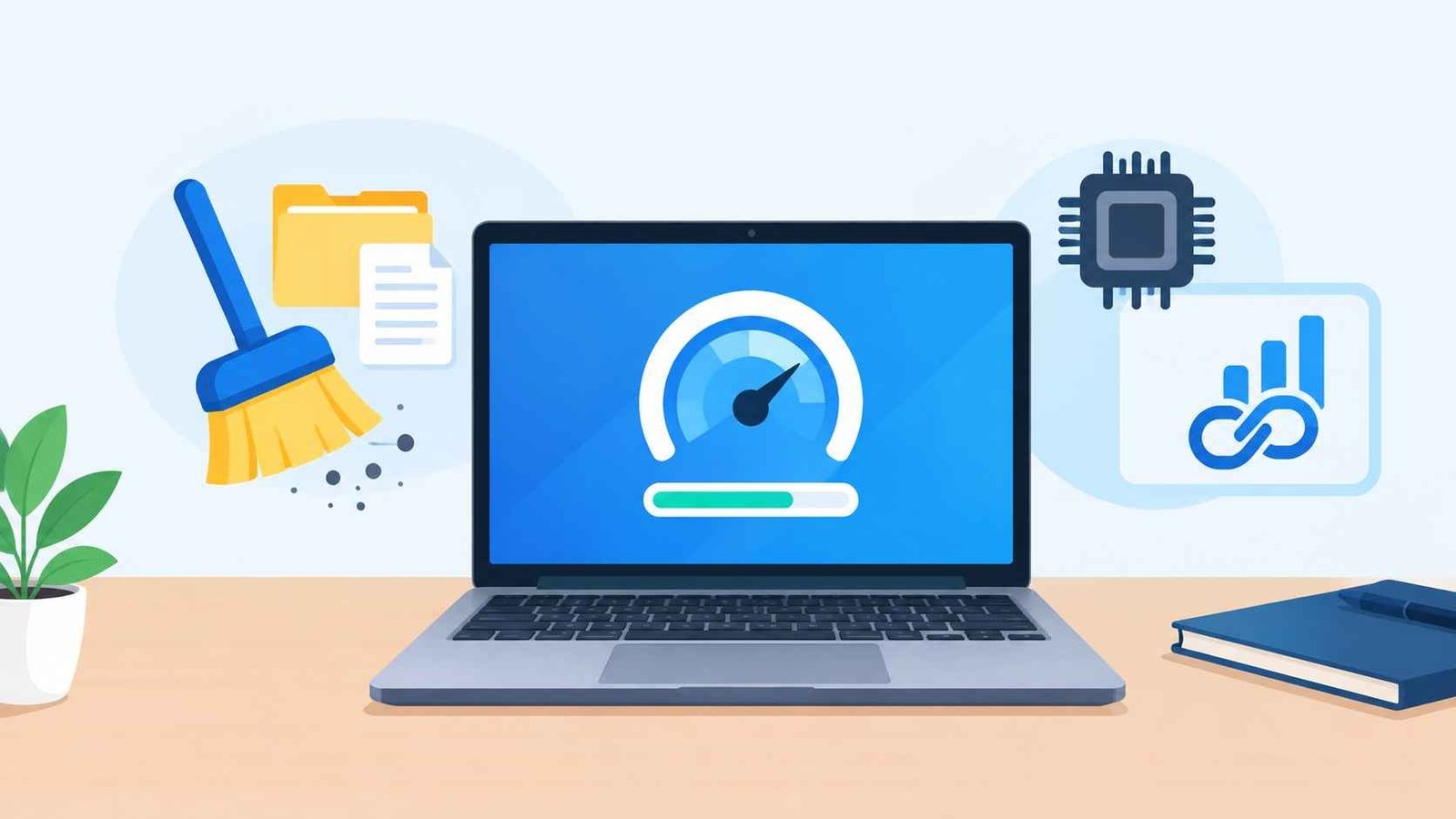
A computer may work perfectly when it is first purchased, but its performance can gradually change with regular use. Over time, temporary files accumulate, applications are installed and removed, storage space becomes limited, and more programs may start running in the background. For gamers and people who use demanding software, hardware limitations can also become more noticeable.
Fortunately, not every performance problem requires a new computer or an expensive upgrade. Simple maintenance can help keep a system organized and responsive. Cleaning unnecessary data, managing installed applications, checking available storage, and understanding hardware limitations are all useful parts of regular PC maintenance.
A PC cleaner can be helpful for dealing with certain types of unnecessary files, while a bottleneck calculator can provide an estimate of whether one hardware component may be limiting another.
Why Does a PC Become Slower?
There are several possible reasons for a computer becoming less responsive. Some are related to software, while others are caused by hardware or environmental conditions.
One common issue is the accumulation of temporary files. Operating systems and applications create temporary data during normal operation. Much of it is eventually unnecessary, but some files can remain on the system for extended periods.
Another factor is the number of programs installed on the computer. Some applications may add background processes or startup entries. When too many unnecessary programs launch with Windows, the computer may take longer to start and have fewer resources available for other tasks.
Limited storage can also affect the overall experience. A drive that is almost full leaves less room for temporary operations and file management. Large downloads, old installers, duplicate files, and unused applications can quietly consume a considerable amount of space.
Hardware aging is a separate issue. A computer that was suitable several years ago may struggle with newer games, editing applications, or multitasking workloads.
What Is a PC Cleaner?
A PC cleaner is a type of maintenance utility designed to identify certain unnecessary files and system clutter. Depending on the software, it may look for temporary files, caches, leftover data, and other items that can potentially be removed.
The main purpose is to keep the system organized and recover storage space rather than dramatically transform an old computer into a new one.
For example, someone who frequently downloads software may eventually have installation files that are no longer needed. Similarly, browsers and applications can accumulate cached information over time.
Before deleting anything, however, it is important to understand what the files are. Not every file identified by a cleaning tool should automatically be removed. Important documents, application data, and system files should be left untouched unless there is a clear reason to delete them.
Users can also perform many cleaning tasks manually through Windows. The operating system includes built-in storage management options that allow users to review temporary files and determine which categories of data can safely be removed.
A third-party tool such as IObit Advanced SystemCare can be another option for users who prefer a more centralized maintenance process, but it should be considered one part of a broader maintenance routine rather than a complete solution to every performance problem.
Simple Ways to Clean Up a Computer
Regular maintenance does not have to be complicated.
Start by checking the main storage drive. If it is nearly full, look for large files that are no longer needed. Downloads folders are often a good place to begin because they can contain old installers, documents, videos, and compressed files.
Next, review installed applications. Programs that are no longer used can be uninstalled through Windows settings. Removing unused applications can free storage and may also reduce unnecessary background processes.
Startup programs are worth checking as well. Some applications automatically launch whenever Windows starts. If a program is not needed immediately after startup, disabling its automatic launch may reduce the workload during boot.
Browser data can also be reviewed periodically. Cached files are useful because they can speed up repeated visits to websites, but they can grow over time. Clearing unnecessary browsing data can recover some storage space.
It is also a good idea to empty the recycle bin and organize important files. A clean folder structure makes it easier to find large or unnecessary files later.
Cleaning Cannot Fix Every Performance Problem
One common misconception is that cleaning a computer will solve all performance issues. In reality, software maintenance has limits.
If a system has insufficient RAM for a particular workload, deleting temporary files will not increase its physical memory. Similarly, an older processor will still have the same processing limitations after a cleanup.
This is particularly important when dealing with gaming performance. If a game consistently delivers lower frame rates than expected, the cause could be related to graphics settings, drivers, temperatures, RAM, storage, or one of the main hardware components.
This is where understanding hardware balance becomes useful.
What Is a Hardware Bottleneck?
A hardware bottleneck occurs when one component limits the performance that another component could potentially provide.
Consider a gaming PC with a high-end graphics card and an older processor. The graphics card may be capable of rendering frames quickly, but the processor may not be able to prepare enough work for it. In that situation, the CPU can become a limiting factor.
The opposite can happen too. A powerful processor paired with a relatively weak graphics card may leave the GPU as the main performance limitation in graphics-heavy games.
Memory capacity and speed, storage performance, cooling, and other components can also influence how a system behaves.
A bottleneck calculator can provide an estimated view of how a particular CPU and GPU combination may perform together. For example, IObit’s Bottleneck Calculator can be used as a starting point when examining a hardware configuration.
However, calculator results should not be treated as exact measurements. Real-world performance depends on factors such as game engines, screen resolution, graphics settings, application optimization, drivers, temperatures, and the specific workload.
When Should You Use a Bottleneck Calculator?
A bottleneck check can be useful before purchasing a major hardware upgrade.
For example, someone considering a new graphics card should not look at the GPU alone. Their existing processor, RAM, power supply, motherboard, and cooling system should also be considered.
The same principle applies when building a new PC. Spending most of the budget on one component while pairing it with significantly weaker hardware may not produce the expected improvement.
A bottleneck calculator can therefore be useful as an initial reference. After getting an estimate, users can investigate actual benchmarks and performance tests for the applications or games they intend to run.
Keep an Eye on Temperatures
Temperature is another important part of PC performance.
Modern processors and graphics cards can reduce their operating speeds when temperatures become too high. This protective behavior helps prevent hardware damage, but it can also reduce performance during demanding workloads.
Dust buildup can make cooling less effective, particularly in desktop computers. Fans and ventilation openings should be kept reasonably clean, and the computer should have enough space for proper airflow.
Laptop users should also avoid blocking ventilation openings. Using a laptop on a soft surface can restrict airflow and contribute to higher temperatures.
If a computer performs well initially but becomes slower during a long gaming or rendering session, temperature may be worth investigating.
Keep Software Updated
Windows and hardware drivers should also be kept reasonably up to date.
Operating system updates can include security patches, bug fixes, and compatibility improvements. Graphics and chipset driver updates may also address compatibility problems or improve performance in certain applications.
However, updates should come from legitimate sources. Users should avoid downloading drivers or optimization utilities from unfamiliar websites simply because they promise dramatic performance improvements.
It is also wise to create backups of important files before making major system changes.
A Practical PC Maintenance Routine
A simple routine can make computer maintenance easier.
Every week, review the Downloads folder and remove files that are no longer useful. Restart the computer regularly and install important updates.
Once a month, check available storage, uninstall applications you no longer use, and review startup programs. This is also a reasonable time to use a PC cleaner if you prefer automated assistance with temporary files and other clutter.
Every few months, check temperatures during demanding workloads and review overall system performance. If gaming performance is unexpectedly low, investigate drivers, graphics settings, memory usage, and hardware utilization.
Before upgrading hardware, consider the entire system rather than focusing on one component. A bottleneck calculator can provide an initial estimate, but actual benchmarks should be used to make the final decision.
Final Thoughts
Good PC performance is usually the result of several small maintenance habits rather than one quick fix. Keeping storage organized, removing unnecessary applications, managing startup programs, updating software, and monitoring temperatures can help a computer remain reliable over time.
A PC cleaner can simplify some of the cleanup work, but it should be used carefully and should not replace sensible file management. Likewise, a bottleneck calculator can help users understand potential hardware limitations, but its results are estimates rather than guarantees of real-world performance.
The most effective approach is to combine basic maintenance with practical troubleshooting. Before spending money on an upgrade, identify what is actually causing the problem. Sometimes a simple cleanup is enough; in other cases, the system may genuinely need more RAM, better cooling, a faster storage drive, or a hardware upgrade.
By understanding the difference between software clutter and hardware limitations, PC owners can maintain their systems more effectively and make better decisions when performance starts to decline.
FAQs
1. What is a PC cleaner?
A PC cleaner helps identify and remove unnecessary files, such as temporary data and cached files.
2. Can a PC cleaner make a computer faster?
It may improve responsiveness by reducing clutter and freeing storage, but it cannot replace outdated hardware.
3. What is a bottleneck calculator?
It estimates whether one PC component, such as the CPU or GPU, may limit another component’s performance.
4. How often should I clean my PC?
A basic cleanup once a month is usually enough for most users.
5. Is a hardware bottleneck always a problem?
Not necessarily. Some level of imbalance is normal, but a significant bottleneck can limit performance in demanding applications or games.